
Postback
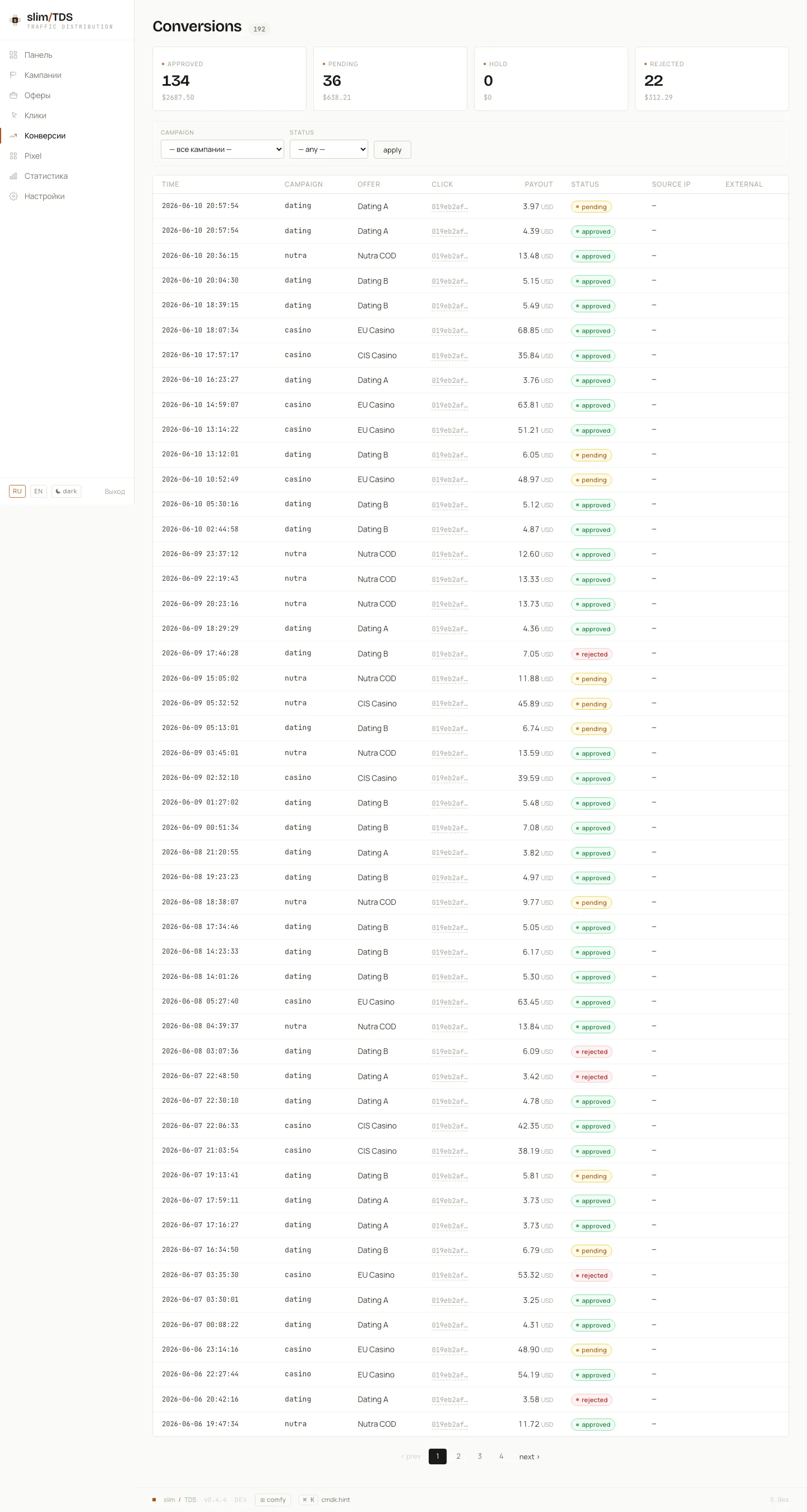
slimTDS handles two directions of postback traffic: incoming (partner networks notifying slimTDS of conversions) and outgoing (slimTDS forwarding conversion signals to your own tracking endpoints). Both are decoupled from the click pipeline so neither blocks visitor redirects.
Incoming postbacks
Section titled “Incoming postbacks”Partner networks call /postback to report conversions. Both GET (query string) and POST (form-encoded or JSON body) are accepted. Query-string parameters take precedence over body keys when both are present.
Parameters
Section titled “Parameters”| Parameter | Notes |
|---|---|
token | Postback token — required. Either a per-offer token or a campaign-level catch-all token. |
subid | Click ID ({click_id} macro value placed in the offer URL). Required for offer-tokens; optional for campaign-tokens. |
payout | Numeric payout amount (defaults to 0). |
status | One of approved, pending, hold, rejected (defaults to approved). |
external_id | Partner’s own conversion identifier (stored for cross-reference). |
Token model
Section titled “Token model”slimTDS resolves the token in two steps:
- Per-offer token — each offer has a unique
postback_token(a random 32-hex-char string). When this token is used, the conversion is attributed to that specific offer. Thesubidmust be a valid click ID that was already recorded instats.clicks. - Campaign-level catch-all token — each campaign also has a
postback_token(a 32-hex UUID-derived string). This allows a single postback URL to handle any offer inside the campaign; the actual offer is resolved from the click row usingsubid. If nosubidis supplied the ping is recorded as an anonymous campaign conversion (see below).
If the token matches neither an offer nor a campaign, the endpoint returns 404.
Idempotency
Section titled “Idempotency”Conversions are upserted into core.conversions with a unique index on click_id. Sending the same subid twice updates payout, status, external_id, and updated_at rather than creating a duplicate row. PostgreSQL NULLs are treated as distinct, so multiple anonymous pings (no subid) can coexist without conflict.
Anonymous campaign pings
Section titled “Anonymous campaign pings”When a campaign-level token is used without a subid — for example, a partner’s test button that does not propagate click IDs — slimTDS records a conversion row with click_id = NULL and offer_id = NULL, tied only to the campaign. This allows operators to count partner events even when per-click attribution is unavailable.
Outgoing S2S postbacks
Section titled “Outgoing S2S postbacks”When a conversion arrives and the matched offer has one or more postback URLs configured (postback_urls JSONB array on core.offers), slimTDS enqueues one core.postback_deliveries row per URL. The row is created synchronously during the incoming postback request, but the HTTP call is never made from the request thread.
The postback:deliver cron command (schedule: * * * * *, every minute) picks up to 50 pending rows and fires each one as an HTTP GET via cURL. On success (HTTP 2xx or 3xx) the row is marked delivered_at = now(). On failure (4xx, 5xx, or network error) the attempt count is incremented and the next retry is scheduled at an exponentially increasing delay.
Retry schedule
Section titled “Retry schedule”Delays are indexed by attempt number (0-based). Up to 5 total attempts are made.
| Attempt | Delay before retry |
|---|---|
| 1st retry | 1 minute |
| 2nd retry | 5 minutes |
| 3rd retry | 25 minutes |
| 4th retry | 2 hours |
| 5th retry | 10 hours |
After 5 failures the row is no longer picked up. Total retry budget is approximately 13.5 hours from the first failure.
Postback URL macros
Section titled “Postback URL macros”Postback URL templates are expanded before delivery. The following tokens are supported:
| Token | Resolves to | Available in outgoing postbacks |
|---|---|---|
{click_id} | The click ID (UUIDv7) originally passed as {click_id} in the offer URL | Yes |
{payout} | Payout amount from the incoming postback | Yes |
{status} | Conversion status (approved, pending, hold, rejected) | Yes |
{external_id} | Partner’s external_id value | Yes |
{currency} | Currency code from the offer (e.g. USD) | Yes |
{visitor_uuid} | Persistent visitor UUID | No — left literal |
{country} | ISO 3166-1 alpha-2 country code | No — left literal |
{region} | Region / subdivision | No — left literal |
{city} | City name | No — left literal |
{device} | Device type (mobile, tablet, desktop) | No — left literal |
{os} | Operating system | No — left literal |
{browser} | Browser name | No — left literal |
{lang} | Accept-Language value | No — left literal |
{ip} | Visitor IP address | No — placeholder 0.0.0.0 |
{ua} | User-Agent string | No — placeholder - |
{referer} | HTTP Referer | No — left literal |
{lander_host} | Originating lander hostname | No — left literal |
{lander_domain} | Lander domain without TLD | No — left literal |
{lander_button} | Lander button/path segment | No — left literal |
{campaign_slug} | Campaign slug | No — left literal |
{timestamp} | Unix timestamp | No — delivery time, not click time |
{utm_source} | UTM source | No — left literal |
{utm_medium} | UTM medium | No — left literal |
{utm_campaign} | UTM campaign | No — left literal |
{utm_term} | UTM term | No — left literal |
{utm_content} | UTM content | No — left literal |
{rand:MIN-MAX} | Random integer between MIN and MAX | No — left literal |
{randstr:N} | Random Base58 string of length N | No — left literal |
Unrecognised tokens are left as-is in the URL.