
How a click is handled
The click pipeline
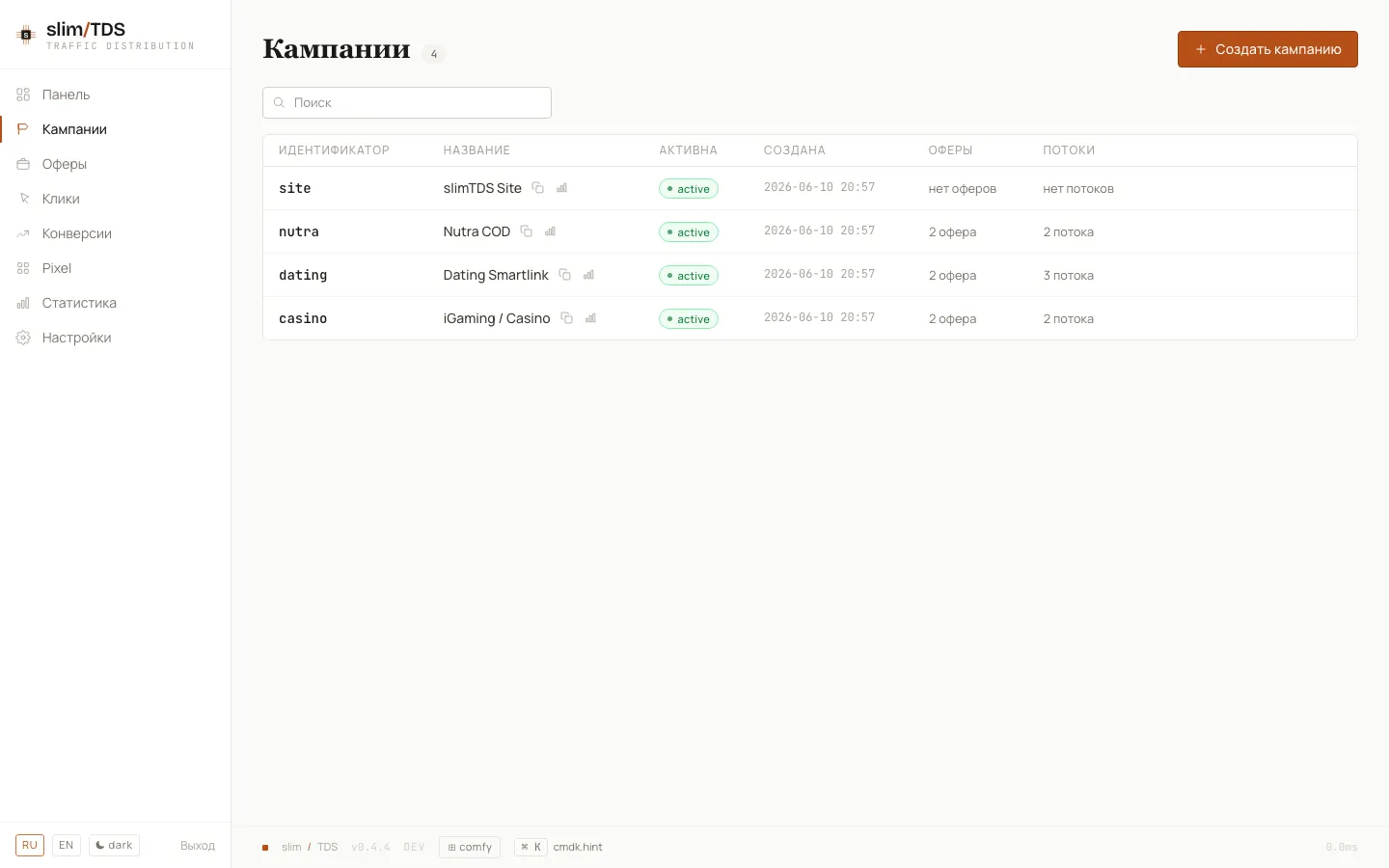
Section titled “The click pipeline”slimTDS runs your organic / SEO traffic through a TDS: every click on a search result or SEO lander lands on /<slug>, where slug identifies the campaign. ClickHandler walks the click through a fixed pipeline:
- VisitorResolver — checks the
vucookie for an existing visitor UUID. If absent, computes a 24-hour fingerprint (SHA-256 of IP + User-Agent + Accept-Language + app secret) and looks it up instats.visitors_fingerprints. If that too misses, mints a new UUIDv7 and records the fingerprint. A separate lookup checksstats.pixel_eventsfor a recent (30-day window) FingerprintJS CE visitor ID from the lander pixel. - DeviceDetector — parses the User-Agent to determine device type, OS, and browser via
mobiledetectlib. - GeoLookup — queries MaxMind GeoLite2 City, Country, and ASN databases to populate country, region, city, ASN, and ISP. Silently no-ops if the
.mmdbfiles are absent fromgeoip-data/. - BotDetector — checks the visitor IP against a bot IP blocklist and ASN table, and the User-Agent against known bot signatures. The list is refreshed daily by the
bots:updatecron. - FlowMatcher + FilterCompiler — iterates the campaign’s active flows in order. For each flow,
FilterCompilercompiles the JSONB filter structure into a PHP closure and evaluates it against the visitor context. First match wins. - OfferPicker — selects an offer from the matched flow’s
target_offerslist. Selection is weighted by each offer’s share of impressions and visitor-stable: the visitor UUID is hashed to produce a consistent point in the weight distribution, so the same visitor always lands on the same offer. - MacroExpander — substitutes tokens in the offer URL and any schema body/url config (see Macros below).
- Schema response — the flow’s configured schema type renders the HTTP response (redirect, iframe, HTML, etc.).
- Click log — the click is written synchronously to
stats.clicks(RANGE-partitioned monthly, BRIN index oncreated_at) before the response is returned.
Data model
Section titled “Data model”Campaigns
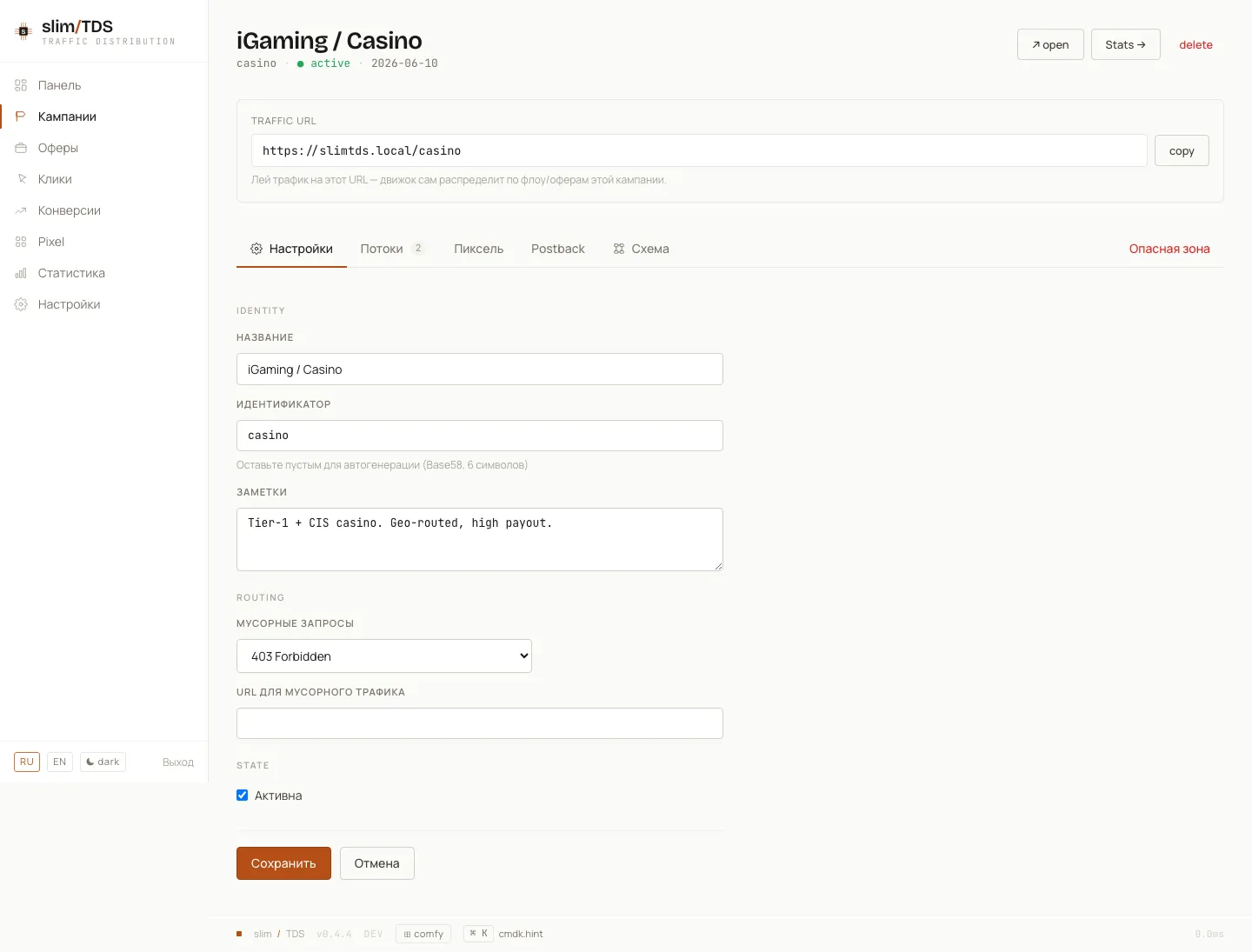
Section titled “Campaigns”A campaign is the entry point for traffic. Its slug is either a Bitcoin-Base58 6-character random string (alphabet excludes 0, O, I, l) or a custom alias matching ^[a-zA-Z0-9]{3,16}$. The slug becomes the live URL: /<slug>.
Global offers
Section titled “Global offers”Offers are global — they are not owned by any campaign. The core.offers table has no campaign_id column. A campaign’s relationship to offers is derived entirely from its flows’ target_offers JSONB field, allowing one offer to be reused across many campaigns simultaneously.
Flows and filters
Section titled “Flows and filters”Each campaign has one or more flows evaluated in order. A flow carries:
- Filters — a JSONB structure
{ groups: [ { conditions: [...] } ] }where conditions are ANDed within a group, and groups are ORed. An empty filter array matches every visitor (catch-all). - Target offers — a list of
{ offer_id, weight }pairs, where each offer’s weight is its share of impressions within the flow. - Schema — how to respond when this flow matches.
Response schemas
Section titled “Response schemas”When a flow matches, the schema type controls how the visitor is delivered to the offer. There are 16 schema types registered in SchemaRegistry:
| ID | Schema |
|---|---|
| 1 | HTTP 301 Redirect |
| 2 | HTTP 302 Redirect |
| 3 | HTTP 303 Redirect |
| 4 | HTTP 307 Redirect |
| 5 | HTTP 308 Redirect |
| 6 | Meta Refresh |
| 7 | Double Meta Refresh |
| 8 | iFrame |
| 9 | HTML Page |
| 10 | Show Text |
| 11 | JSON |
| 12 | Curl Proxy |
| 13 | No Action (200 blank) |
| 14 | HTTP Code |
| 15 | Formula |
| 16 | JS Redirect |
New schemas can be added by registering an additional entry in SchemaRegistry.
Macros
Section titled “Macros”MacroExpander substitutes tokens in offer URLs, postback URL templates, and schema body/url config fields at request time:
| Token | Resolves to |
|---|---|
{click_id} | UUIDv7 click identifier |
{visitor_uuid} | Persistent visitor UUID |
{campaign_slug} | Campaign slug |
{country} | ISO 3166-1 alpha-2 country code |
{region} | Region / subdivision |
{city} | City name |
{device} | Device type (mobile, tablet, desktop) |
{os} | Operating system |
{browser} | Browser name |
{lang} | Accept-Language value |
{ip} | Visitor IP address |
{ua} | User-Agent string |
{referer} | HTTP Referer header |
{bot} | Bot name (if detected) |
{lander_host} | Originating lander hostname |
{lander_domain} | Lander domain without TLD |
{lander_button} | Lander button/path segment |
{timestamp} | Unix timestamp |
{utm_source} | UTM source parameter |
{utm_medium} | UTM medium parameter |
{utm_campaign} | UTM campaign parameter |
{utm_term} | UTM term parameter |
{utm_content} | UTM content parameter |
{rand:MIN-MAX} | Random integer between MIN and MAX |
{randstr:N} | Random Base58 string of length N |
{spin:a|b|c} | Uniform-random pick from a |-separated list |
Unrecognised tokens are left as-is.
{spin} — rotating landings in one offer
Section titled “{spin} — rotating landings in one offer”{spin:a|b|c} picks one of the pipe-separated values uniformly at random on every request. Whitespace around each value is trimmed and empty segments are dropped; if nothing valid remains it resolves to an empty string so the literal never leaks into a URL. Weight a value by repeating it — {spin:a|a|b} yields a two-thirds of the time.
Because it expands anywhere macros run, the common use is rotating landing pages inside a single offer without creating an offer per landing:
{spin:https://land-a.example/go|https://land-b.example/go}Unlike offer-share weights, {spin} is not visitor-stable — the same visitor may hit a different value on a repeat click.
{offer:<name\|id>} — reference another offer
Section titled “{offer:<name\|id>} — reference another offer”{offer:...} is a reference, not an inline macro, and is only recognised as the whole value of a campaign’s trash_url (Settings → Trash). It resolves to the referenced offer’s own URL, which is then macro-expanded — so that offer’s {spin}, {click_id}, etc. fire as usual. The reference is matched by offer UUID first, then by exact offer name (newest wins on a name collision). An unresolvable reference sends the visitor a 204. See Trash traffic.